There’s a verge at the end of most streets where the council stopped mowing a few years ago. In late spring it turns into a ragged strip of yellow, white and blue that nobody planted and almost nobody looks at. That’s where wildflower spotting begins — not in a nature reserve with a visitor centre and a car park charge, but on the walk you were doing anyway. You don’t need qualifications, expensive kit or a degree in botany. You need a bit of patience, a willingness to crouch down, and the ability to leave things exactly as you found them.
This guide is for the curious walker who wants a low-cost hobby that gets them outside. It covers what to carry, when to go, where to look, how to identify plants without leaning on an app, and how to record what you see without disturbing it. If you’ve ever wondered what that pink thing on the wall is, this is how to get started with wildflower spotting properly.
What to Take (and What You Can Leave at Home)
The honest answer is: less than you think. A lot of beginner guides make wildflower spotting sound like fell walking, with a rucksack full of gear. It isn’t. The plants aren’t going anywhere, and you’re rarely more than ten minutes from a cup of tea.
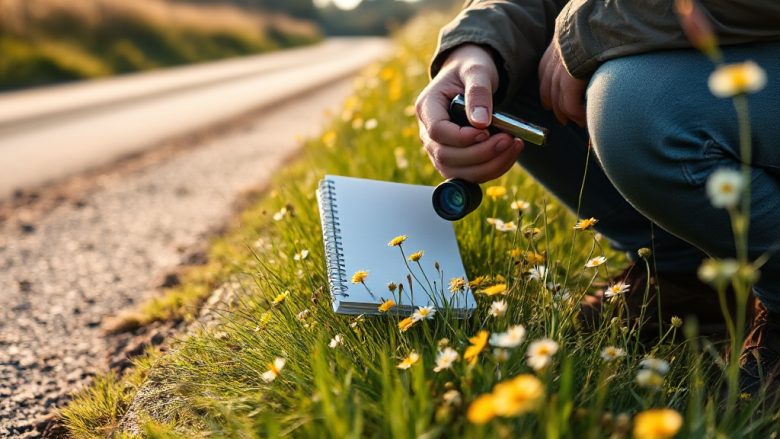
Start with a small notebook and a pencil. Pencils work in the rain and don’t run out of ink at the worst moment. A hand lens — the little folding jeweller’s type, usually a ten-times magnification — costs a few pounds and turns a tiny white flower into something with hairs, glands and a very specific centre. It’s the single most useful piece of kit you can buy, and it fits in a coat pocket.
A phone is fine for photographs, but resist the urge to use it as your only identification tool. More on that below. If you want to press specimens, a folded sheet of newspaper and two heavy books will do; you don’t need a proper press until you’ve been at this for a year. Wear shoes you don’t mind getting muddy and trousers that won’t complain about a bit of bramble. That’s the whole kit list.
One thing worth carrying: a small bag for litter. Verges and path edges collect cans and crisp packets, and picking up two or three as you go is a decent way to leave a place better than you found it.
When to Go and Where to Look
Wildflower spotting has a season, and it runs roughly from March to September, with the richest months in most of the UK falling between May and July. Early spring belongs to the small stuff — lesser celandine, wood anemone, the first dandelions. High summer brings the tall, showy plants: knapweed, ox-eye daisy, meadowsweet, purple loosestrife. By September you’re into the seed heads and the last of the scabious, which is a different pleasure altogether.
Timing within the day matters too. Flowers open and close. Some, like goat’s-beard, only perform in the morning sun. Others, like the evening primrose, wait until late afternoon. If you visit the same patch at different times, you’ll notice it looks like a different place.
As for where, start where you already walk. Path edges, roadside verges, the strip between a pavement and a hedge, churchyards, canal towpaths, the rough corner of a park that the mower misses. These scruffy, in-between places are often richer than a manicured meadow, because they’ve been left alone long enough for something to take hold. A wall can be a habitat. So can a crack in a kerb. Look down more than you look up.
Once you’ve got your eye in on familiar ground, you can branch out to bigger sites. But there’s no rush, and the plants on your own street will teach you more in a month than a single trip to a famous reserve.
How to Identify a Flower Without an App
This is the part that intimidates people, and it shouldn’t. You don’t need to name everything. Naming ten per cent of what you see is a good day. The trick is to work through a few simple questions in order, rather than trying to match a photo.
First, count the petals. Is it four, five, or many? A flower with four petals is likely in the cabbage or poppy family; five petals suggests rose, geranium or campion; a daisy-like head is a composite, which is really hundreds of tiny flowers packed together. This one question narrows things down enormously.
Second, look at the leaves. Are they opposite each other on the stem, or alternating? Are they smooth-edged or toothed? Hairy or glossy? Leaf shape is often more reliable than flower colour, which varies with soil and light.
Third, note the habitat. A plant growing in a bog is not the same as one on a chalk down, even if the flowers look similar. Habitat is a clue, not a detail.
Fourth, use a field guide — a physical book, ideally one with keys rather than just pictures. Picture-matching guides are lovely for browsing but they teach you very little. A key forces you to look at the plant properly. The classic approach is to start with the family, then work down. It’s slow at first. After a few weeks it becomes quick.
Apps have their place, but they’re a crutch. They’re often wrong on tricky groups like willowherbs, umbellifers and dandelion-type plants, and they encourage you to accept a name without looking. Use one to get a suggestion, then verify it in a book. If you can’t verify it, write it down as ‘possible’ and move on. Uncertainty is part of the hobby, not a failure of it.
One more thing: learn a handful of common plants really well. If you know nettle, cow parsley, buttercup, daisy and dandelion, you’ve got a baseline against which everything else stands out.
Recording What You See Without Disturbing It
A record can be as simple as a date, a place and a name. That’s it. A notebook entry like ’14 June, canal path behind the retail park, meadow cranesbill, lots’ is a perfectly good record. Over a year, those entries become something more interesting: a picture of what appears when, and how the seasons shift.
Photographs help, but take them for the right reasons. A photo of the whole plant, then a close-up of the flower, then a shot of the leaves and stem, will serve you far better than a single pretty bloom. Include something for scale if size matters — a coin works. And note the location, because a photo without a place is just a picture.
Now the important part: don’t pick. Not the flower, not the leaf, not the seed head. Wild plants are food and shelter for insects, birds and small mammals, and many are legally protected. On public land, picking is often an offence; even where it isn’t, a picked flower is a flower nobody else gets to see. If you want to examine something closely, use your hand lens, or lie down next to it. If you genuinely need a specimen for identification, take one leaf from a large, abundant population, never from a rare plant, and never from a site where it’s the only one.
Stay on the path where paths exist. Trampling is the quiet killer of verge flora. Keep dogs close, don’t let them crash through the long grass, and take your litter home. The best wildflower spotters are the ones you’d never know had been there.
Finally, don’t worry about being good at this. The point isn’t to build a perfect list. It’s to slow down, look properly at something small, and let a scruffy patch of roadside become a place you know. Start this week, on your normal route, and see what’s already growing there.