There’s a version of sustainable living that exists mostly online: glass jars arranged by size, a linen bread bag, a child who happily eats lentil stew. Then there’s the version that happens in an actual house, at 7.40am, when one shoe is missing and the school run leaves in nine minutes. I’ve spent years trying to close the gap between those two worlds, and most of what I’ve learned is that the changes which survive are rarely the ones that look good in photos. They’re the ones that cost nothing extra, take no extra time, and don’t collapse the moment someone has a bad week.
So this isn’t a list of aspirational projects. It’s a list of swaps and habits that have already been tested against a chaotic household, sorted into two tiers: five things you can start this month, and five worth considering next year when you have more headroom. If you’re searching for sustainable living tips for families that don’t assume unlimited time, money or storage space, start with the first five and ignore the rest until they feel possible. That’s genuinely the point.
Five changes to make this month
These are the low-friction wins. None of them require a new hobby, a shed full of equipment, or a family meeting. They mostly work because they replace something you already do with a slightly better version of the same thing.
1. Put a lidded bin next to the kitchen bin for food scraps
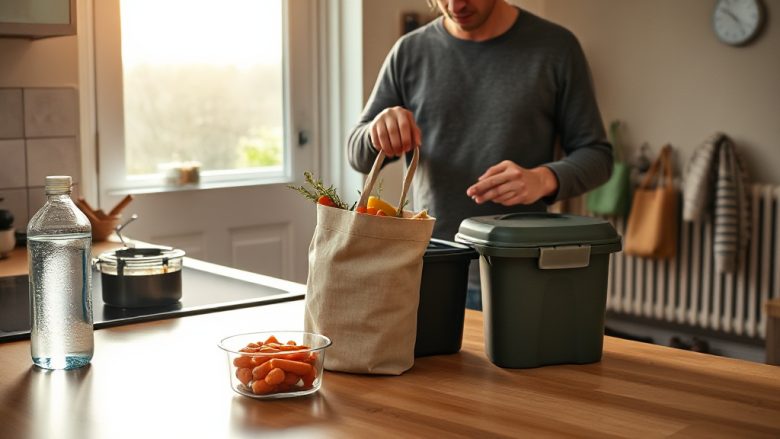
Food waste is one of the few environmental issues where the fix is almost embarrassingly simple. A small caddy with a lid, lined with a compostable bag, sits right beside the main bin so nobody has to walk anywhere or remember anything. In our house the caddy filled up faster than expected, and the main bin emptied far less often, which meant fewer bin bags and fewer trips outside. If you don’t have a garden, many councils collect food waste separately, and the caddy works exactly the same way for that. Why it sticks: it lives where the rubbish already goes, so no one has to change their route through the kitchen.
2. Swap one laundry habit, not all of them
Laundry is where good intentions go to die. You do not need to wash everything at 20 degrees, air-dry every sock and make your own detergent. Pick one change. For us it was dropping to a cooler wash cycle for everything except genuinely soiled sports kit, which cut the energy per load without anyone noticing a difference in cleanliness. The second change, if you have the space, is a drying rack on a radiator or in a doorway rather than the tumble dryer for the easy loads. Why it sticks: one variable changed, so there’s nothing new to remember and no argument about whose turn it is.
3. Keep a reusable bag actually in the car
The reason reusable bags fail is logistics, not commitment. They’re at home when you’re at the shop. The fix is unglamorous: fold two or three sturdy bags into the boot or the bottom of the pushchair and leave them there permanently. If you walk to the shops, hang one on the buggy handle or keep a compact one in your coat pocket. This is the least interesting tip in the article and the one that has saved the most plastic in our house by a wide margin. Why it sticks: it removes the need to remember, which is the only real obstacle.
4. Buy the boring version of things you replace often
Families go through a lot of the same items on repeat: cleaning spray, hand soap, kitchen roll, cereal, pasta. Choosing refill pouches or larger formats for even two or three of these cuts packaging steadily without a single lifestyle change. It also tends to be cheaper per use, which matters when you’re buying for four people. You don’t have to switch brands or hunt down a zero-waste shop. Just buy the big one instead of the small one. Why it sticks: it’s a decision you make once in the aisle, not a routine you have to maintain.
5. Set the heating to a schedule instead of a mood
Most homes heat themselves based on whoever feels coldest at any given moment. A simple timer that warms the house before the morning rush and again in the evening, and drops back while everyone’s out or asleep, reduces energy use without anyone being uncomfortable during the hours that matter. Add a jumper to the sofa and you’ve covered most of the complaints. If your system has a thermostat you can program, this takes about ten minutes and then runs itself. Why it sticks: once it’s set, it works whether or not anyone remembers to think about it.
Why small family swaps beat grand plans
The reason these five work is that they don’t depend on motivation. Motivation is a terrible fuel source when you have children, because it runs out precisely when you need it most. A bin in the right place, a bag in the boot, a wash cycle you don’t think about, a thermostat doing its own thing: these are systems, not choices. Systems survive bad weeks. Choices don’t.
There’s also a money argument that gets overlooked. A lot of sustainable living advice quietly assumes you’ll spend more, on organic produce, on durable goods, on the specialist shop. Some of that is genuinely worth it, but the changes above mostly cost the same or less. Buying larger formats is cheaper. Washing cooler is cheaper. Heating on a schedule is cheaper. That matters, because a habit you can’t afford is a habit you’ll drop the first time the boiler needs replacing.
The last thing worth saying about this tier is that it’s enough. You don’t have to do all five. Two of them, done consistently for a year, will do more than a fortnight of enthusiastic overhaul followed by exhaustion. Pick the ones that fit your house and let the others wait.
Five changes worth considering next year
These are the ones that need a bit more space, money or mental bandwidth. They’re not better than the first five, just bigger. Come back to them when the school year has settled and you’re not already running on empty.
6. A proper second-hand habit for kids’ clothes and kit
Children outgrow things faster than they wear them out, which makes them ideal candidates for buying used. The reason this sits in the later tier is that it takes a while to learn your local options: which charity shops actually stock good kids’ sizes, which school uniform sales are worth attending, which neighbours have children a year ahead. Once you’ve found two or three reliable sources, it becomes almost automatic and saves real money. Why it sticks: it’s cheaper than buying new, so there’s a practical reward beyond the environmental one.
7. Growing something edible, in whatever space you have
You don’t need an allotment. A windowsill of herbs, a couple of tomato plants in bags by a sunny wall, or a single strawberry pot will do. The catch is that growing things takes attention, and attention is exactly what’s scarce in a busy household, which is why this belongs in the later tier. Start with herbs, which are hard to kill and expensive to buy fresh. If that survives a season, expand. Why it sticks: children tend to eat what they’ve grown, so it doubles as a way to get them interested in food.
8. A household repair evening once a month
So much of what gets thrown away is one loose screw or one broken zip away from being useful. Setting aside an hour a month to fix the pile of small broken things, with a basic kit of glue, needle and thread, and a few screwdrivers, keeps clothing, toys and small appliances in circulation. It works best when it’s a shared job rather than one person’s chore. Why it sticks: it’s scheduled, so it doesn’t rely on finding the time spontaneously.
9. Switching to a green energy tariff or a smart meter
This is a paperwork job rather than a daily habit, which is why it keeps getting postponed. It’s worth doing when you have a quiet evening, because it shifts a large chunk of your household footprint without changing anything about how you live. A smart meter also makes the first-tier heating tip easier, since you can see what’s actually costing you money. Why it sticks: once it’s done, it’s done, and it keeps working in the background.
10. Rethinking one big purchase rather than ten small ones
The single biggest environmental decision most families make is not about bags or bulbs. It’s about the car, the boiler, the holiday, the extension. When one of those is due, it’s worth slowing down and asking whether a smaller or second-hand option would do the job. This is a later-tier item because it only comes up occasionally and it needs proper thought, not a rushed decision in a showroom. Why it sticks: it’s a one-off choice with long consequences, so the effort is spread over years.
Start where you are, not where the internet says you should be
The honest truth about sustainable living tips for families is that the useful ones are dull. They’re bins and bags and wash cycles and thermostats. They don’t photograph well and nobody will congratulate you for them. But they’re the ones still running in our house three years later, long after the ambitious projects were quietly abandoned.
So take the first tier and ignore the second until it’s genuinely useful to you. If you only manage the caddy and the cooler wash this month, that’s a real change, made in a real household, with real children underfoot. Next year you can add another. That’s how this actually works, and it’s the only version I’ve seen survive a school run.